
The Business of AI Coding Downtime
I spend my days orchestrating AI architectures for freelancers and SMEs…
My daily grind is transforming vague business needs into systems that actually run without breaking. To do that, I use VS Code, Terminal windows… and I spend a considerable amount of time waiting for my chosen coding LLM—GLM5.2, Minimax M3, etc.—to finish generating a complex block of code. This is what we call « downtime. » It’s frustrating, it’s empty, and that’s exactly where IdlePay stepped in.
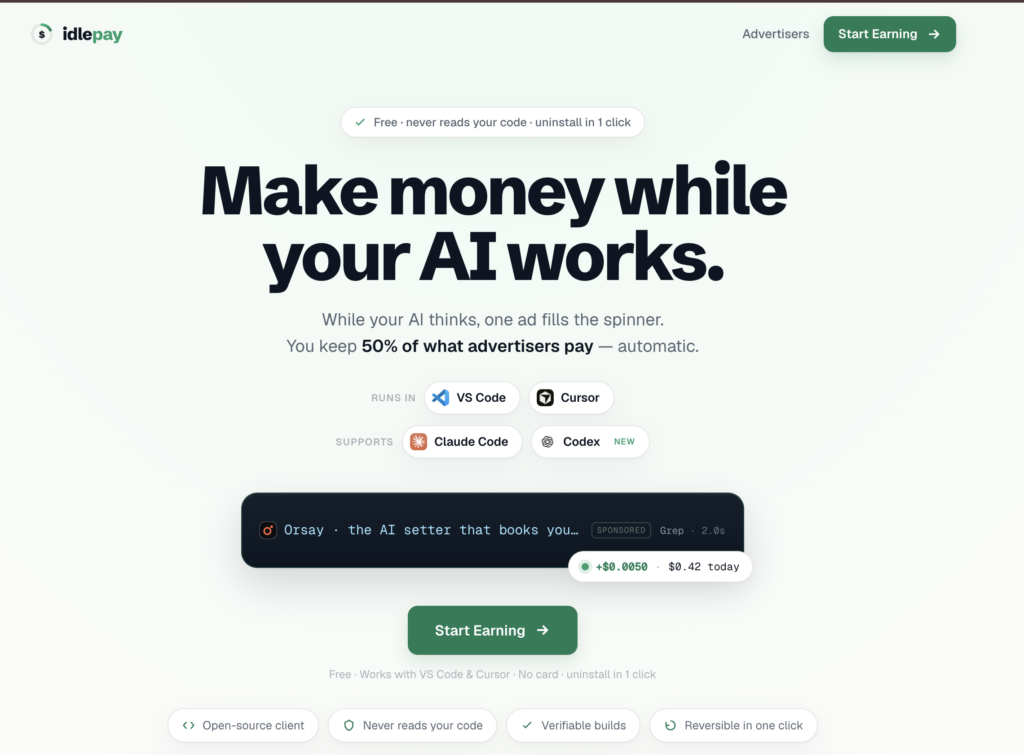
The concept is simple: turn your code editor’s loading spinner into an advertising space.
While the AI is thinking, a sponsored line appears.
You earn money on every impression and keep 50% of the generated revenue.
It’s a pragmatic, almost brutal approach that treats a developer’s attention as advertising inventory.
I find the idea gutsy because it attacks a sanctuary: the development environment.

We’re not talking about an intrusive banner that hides your code or an unbearable pop-up. We’re talking about replacing a word like « Thinking… » with a line of sponsored text.
It’s discreet, it’s surgical. The system is based on real-time bidding, and if you click, the gain is multiplied by fifty.
It’s the classic RTB model applied to the software engineering niche.
Frictionless Installation and the Simplicity Trap
Access is through the official VS Code or Cursor marketplace. No terminal to configure, no credit card to pull out, no complex account to create.
You install the extension, log in once, and that’s it. I know that for an SME owner or a senior dev, every second spent configuring a tool is a second wasted.
Here, the promise is « zero effort. »
Payment is handled by Stripe, with a ten-dollar withdrawal threshold. That’s honest. They aren’t promising to replace your salary, and that’s where I agree with the product’s positioning.
The idea isn’t to get rich off ads, but to claw back a bit of cash from time you’d burn anyway. It’s found money, not a business plan.
Technical Transparency to Calm the Anxiety
In my job as an AI Architect, security isn’t an option. I don’t let anything into my production environment without knowing exactly what it does. IdlePay plays the total open-source card. Every line of code running on your machine is public and verifiable.
They even use verify.sh to prove that the version published on the store is identical to the public source code.
The extension is sandboxed. It only touches the AI spinner. It doesn’t read your files; it doesn’t scan your environment variables. This is a crucial point because the dev community is allergic to tools that could exfiltrate API keys or proprietary code.
The fact that the script linked to the Claude Code configuration is about fifty lines and makes no direct network calls is a strong argument for those who, like me, read the code before installing it.

The Hidden Cost of Fragmented Attention
This is where I radically diverge from the marketing pitch. IdlePay claims that nothing changes in your workflow. That’s technically true, but psychologically false.
As an architect, I know that « flow » is a developer’s most precious resource. The moment the AI is thinking is often the moment the human brain anticipates the solution, structures the next step, or verifies the logic of the previous block.
Introducing an ad, even a single line, is injecting an external stimulus into an intense thinking process. According to some cognitive ergonomics studies, the recovery time after a distraction, even a minimal one, can take several minutes to return to a state of deep concentration. We are potentially trading a fraction of a cent for a micro-break in focus.
The ROI calculation then becomes ambiguous. If you earn a few dollars a month but your productivity drops by 2% because of these micro-interruptions, you’re losing. For a freelancer paid, for example, 500 euros a day, the opportunity cost is massive. It’s the paradox of the tool: it pays you for your downtime, but it pollutes your thinking time.
Dependence on Third-Party Platforms
Another point that makes me twitch is the total dependence on editors like Cursor or VS Code. IdlePay relies on specific hooks. If tomorrow Microsoft or the Cursor team decides to block these kinds of modifications to « preserve the user experience, » the tool disappears or becomes obsolete overnight.
We end up with an economic model that survives thanks to the loopholes or tolerances of software giants. It’s a risky bet in the long run. You don’t build a solid infrastructure on land where you don’t hold the keys. It’s a financial gadget, not a transformation of work.
Real Value vs. Earning Promises
Let’s be blunt: how much are you actually going to earn? The text mentions revenue based on live auction prices. In reality, to reach the ten-dollar Stripe threshold, you have to spend hours and hours in a waiting state. For most users, it will be a negligible supplement.
I’m not saying it’s useless, but we need to stop the fantasy of « AI that pays for itself. » Unless you spend ten hours a day generating thousands of lines of code with complex prompts that require long AI thinking times, the gains will be anecdotal.
The mental effort of managing an additional extension and the visual distraction could cost more than the financial gain.
Data Obsession and the Reality of Tracking
IdlePay insists that they don’t collect your prompts, your code, or your conversations. That’s their main argument. To differentiate a developer who is actively coding from a terminal left open, they only use the timestamp of the Claude session transcription file. It’s an ingenious and minimalist approach.
However, it’s clear that in the world of AI, the line between « metadata » and « sensitive data » is porous. The simple fact of knowing when you work, how long you wait, and how often you call upon the AI is already valuable information about your behavior and productivity. It’s a form of surveillance, even if it’s consented to and monetized.
Open Source as a Shield, Not Proof
The open-source argument is often used to reassure. It’s effective, but insufficient. Few people are actually going to read fifty lines of script or verify build signatures on verify.sh. The majority of users will simply « trust » because the words « open source » are written in bold.
This is a classic cognitive bias. We confuse the possibility of verifying with actual verification. The risk isn’t so much that the current code is malicious, but that the project’s governance changes. If IdlePay is bought by a data-mining firm, the transition to a less transparent model could happen very quickly, and you’d have already installed the extension and linked your Stripe account.
The Risk of Normalizing Ads in Code
If this model becomes widespread, we risk seeing « Freemium » versions of code editors where advertising is native. Imagine a free VS Code, but with ads in the spinner, in the status bar, and maybe even sponsored library suggestions in the autocompletion.
It’s a slippery slope. By agreeing to monetize our wait time today, we validate the idea that the developer’s workspace is advertising inventory. It’s short-term thinking. Coding is an art of precision; injecting commercial noise into it, even minimally, is a strategic error in terms of user experience.

The Architect’s Verdict: Gadget or Useful Tool?
To wrap up, IdlePay is an interesting experiment in monetizing latency. It’s technically clean, honestly presented, and transparent about how it works. The 50% revenue share is generous for this type of service, and the Stripe integration makes it concrete.
However, I only recommend this tool to a specific profile: the junior developer or student on a tight budget who spends a crazy amount of time learning by making mistakes and waiting for the AI to fix their scripts. For them, a few dollars a month can help pay for an API subscription or a coffee.
For the senior, the lead dev, or the SME owner, the calculation is different. Your attention is your value. Fragmenting it to earn cents is a bad trade. The cognitive cost of distraction, even slight, far outweighs the financial gain. You don’t sell your attention at the price of a click when you sell your expertise by the hour.
The tool does exactly what it promises: it turns emptiness into money. But be careful not to turn your workspace into an ad agency just because it’s « free » or « profitable. » Real profitability is execution speed and mental clarity, not the balance of a Stripe account fed by sponsored lines of text while you wait for Claude to finish thinking.
The market has already decided on the value of attention: it has become the most expensive resource in the world. Wanting to sell it for the price of an ad impression is, in my opinion, a casting error.
[Want to test it yourself? Here is the link [How to Install IdlePay]]
Ready to finally take action?
I have a special offer to help you see more clearly and get concrete results quickly.
The DHS Discovery Pack is made for this: we look together, in one session, at what can be delegated in your business, and you leave with a clear roadmap.
No bullshit, no commitment, no 7-step method. Just concrete results: that’s my WHY: being USEFUL, and everyone who knows me can testify to that.
Thanks for reading… all the way to the end…
CDAL
PS: This article was proofread and edited by me
—
Ready to finally take action? I’ve got a special offer to help you see clearly and get concrete results fast.
The Discovery Pack Digital HS is built for that: we look together, in one session, at what can be delegated in your business, and you walk away with a clear roadmap.
No bullshit, no commitment, no 7-step method.
Just concrete: that’s my WHY — to be USEFUL, and everyone who knows me can vouch for that.
Thanks for reading me …. all the way through …..
CDAL
PS: this article has been reviewed and edited by me
—
