1. THE CONTEXT: The End of “Chatty” AI, The Dawn of “Active” AI
Since the meteoric rise of ChatGPT and Google Gemini, the business world has been captivated by Generative AI. Until now, however, this technology has functioned primarily as a brilliant but paralyzed consultant: capable of writing sonnets, analyzing balance sheets, or summarizing emails, but utterly incapable of acting on the physical or digital world. It was trapped inside a “chat box.”
Google’s focus on the Interactions API marks a decisive turning point. We are moving beyond the era of simple text generation and entering the era of Agentic AI.
Key Definition: Agentic AI
Imagine the difference between an intern who only takes notes (classic Generative AI) and an executive assistant who can call clients, book flights, and modify your calendar autonomously (Agentic AI). Agentic AI has the ability to perceive its environment, reason, and most importantly, execute tasks independently via external tools.
This API acts as the missing bridge. In the current economic climate, where companies are desperate to automate not just repetitive tasks (as RPA – Robotic Process Automation did in the 2010s) but complex cognitive processes, this technology represents a rupture. It empowers developers to transform Gemini from a simple chatbot into a genuine digital employee capable of interacting with your applications, databases, and third-party services.
2. UNDER THE HOOD: Simplified Technical Analysis
To grasp the power of the Interactions API, one must first understand how Artificial Intelligence “sees” the digital world.
The Problem of Hallucination and Isolation
An LLM (Large Language Model), such as Gemini, is by default a “brain in a jar.” It has learned everything available on the Internet up to a certain date, but it does not know the current state of your inventory, nor the content of the email you received 5 minutes ago. If you ask it to “book a meeting room,” it might generate a text response saying “It’s done!”, but nothing will actually happen because it lacks the “hands” to click inside your calendar software.
The Solution: The API as “Digital Hands”
This is where the API (Application Programming Interface) comes into play.
Analogy: The Waiter at a Restaurant
Think of an API as a waiter in a restaurant. You (the user or the AI) are at the table and want something from the kitchen (the database or software). You cannot enter the kitchen yourself. The waiter (the API) takes your order, delivers it to the kitchen, ensures the chef (the software) does the work, and brings you the result.
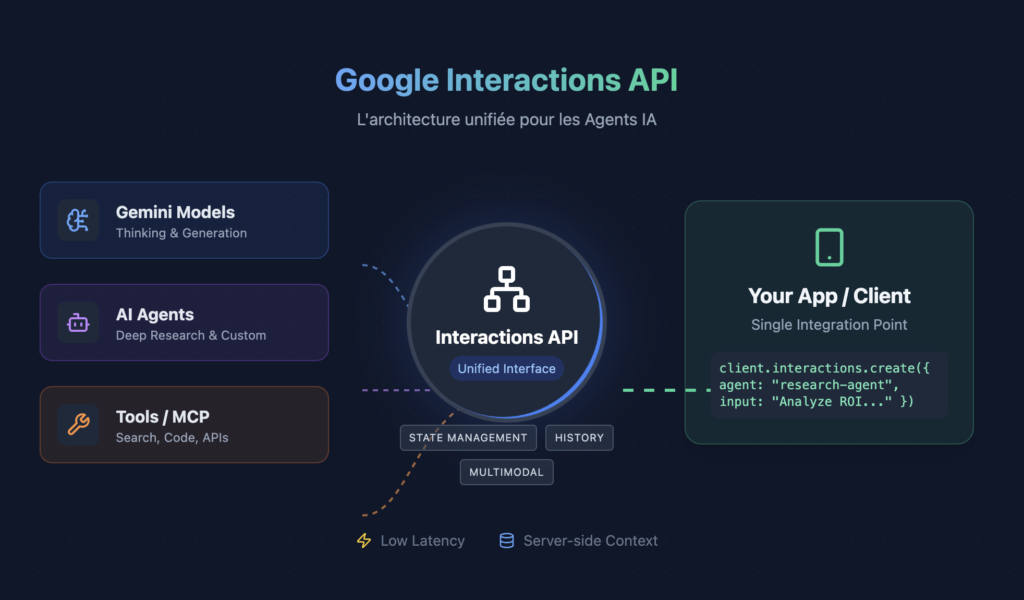
Google’s Interactions API standardizes how the “brain” (Gemini) talks to the “hands” (your tools).
- Tool Definition: The developer explains to the AI: “Here is a toolbox. This tool is for sending an email; that one is for searching the client database.”
- Reasoning: The user asks: “Check if client Smith has paid his invoice and send a reminder if necessary.” The AI analyzes the request and understands it must first use the “Check Invoice” tool, analyze the result, and potentially use the “Send Email” tool.
- Secure Execution: The Interactions API manages this flow. It allows the AI to send commands to enterprise software in a structured and secure manner.
Multimodality: The Game Changer
The most revolutionary aspect of this development is multimodality. The AI is no longer limited to reading text. It can “see” and “hear.” If you show the AI a photo of a defective part on an assembly line (visual input), the Interactions API allows it to not only identify the fault but to immediately trigger a replacement order in the company’s SAP software.
3. OPERATIONAL IMPACT: The Trinity of Value
Adopting this technology should not be viewed merely as an IT update, but as a lever for financial and operational performance.
A. Efficiency: Compressing Time
The primary gain lies in the reduction of cognitive latency. Today, an employee spends roughly 20% of their time switching between applications (known as “context switching”).
- Before: An employee reads an email, opens the CRM, copies the name, searches for the file, opens Excel, checks stock, returns to the email, drafts a response. (Estimated time: 8 minutes).
- After: The Interactions API allows an AI agent to perform all these steps in the background while the employee simply validates the final action. (Estimated time: 30 seconds). Across a team of 100 people, this represents thousands of saved hours annually.
B. Profitability: Reducing OPEX (Operating Expenses)
Integration via this API significantly reduces development costs. Previously, building bridges between an AI and internal systems required weeks of complex coding (“Hard-coding”). The Interactions API simplifies this digital plumbing. Furthermore, by automating Tier-1 tasks (standard responses, simple verifications), the company reduces customer support costs while increasing availability (24/7).
C. Automation: Towards the Autonomous Enterprise
We are shifting from a “Human-in-the-loop” model (human does the work, AI helps) to a “Human-on-the-loop” model (AI does the work, human supervises). The API enables the creation of complex workflows where the AI chains together 5 or 10 consecutive actions without human intervention, provided the confidence level is high.
4. CONCRETE CASE STUDY: “LogistiCorp Inc.”
To illustrate the power of the Interactions API, let’s imagine a fictional SME, LogistiCorp Inc., specializing in emergency medical supply distribution.
The Initial Situation (Chaos)
Customer service receives 500 emails daily. Hospitals are asking about their orders. Operators must:
- Read the email.
- Identify the order number.
- Log in to the carrier software (FedEx/DHL).
- Log in to the internal ERP to check stock.
- Reply to the customer. Problem: Data entry errors, 4-hour response delays, team burnout.
Implementing the Interactions API
LogistiCorp deploys a Gemini AI agent connected via the Interactions API to its ERP and the carrier’s API.
The “After” Scenario
- Reception: An email arrives: “Urgent, where are our catheters? Order #12345”.
- Perception & Reasoning: The AI reads the email, detects the urgency and the order number.
- Action (via API):
- The AI queries the carrier API: “Status of package #12345?”. Response: “Held at customs.”
- The AI queries the internal ERP: “Do we have stock to resend an express order?”. Response: “Yes.”
- Resolution: The AI drafts a response for the human supervisor: “Hello, your package is held up. To avoid delay, I have prepared a new express shipment leaving tonight. Do you approve?”
- Validation: The human clicks “Yes.” The AI triggers the shipping order in the ERP itself.
Result: Processing time drops from 15 minutes to 30 seconds. Customer satisfaction skyrockets.
5. RISKS, LIMITS, AND ETHICS
Enthusiasm must not overshadow prudence. Giving “hands” to an AI involves tangible risks.
- The Risk of Unintended Action: If the AI hallucinates (invents information) and has the power to delete files or order 10,000 units of stock, catastrophe is possible.
- Solution: Implement Guardrails and always maintain human validation for critical actions.
- Security and Privacy: Connecting an AI to your internal databases requires a robust security architecture. Data must not be used to train Google’s public model (unless otherwise agreed).
- Token Costs: Every interaction, every back-and-forth between the AI and the API consumes computing resources (tokens). Poor optimization can lead to surprising cloud bills.
6. CONCLUSION & STRATEGIC VISION
Google’s Interactions API is not “just another feature.” It is the signal that AI is ready to leave the laboratories and enter factories and offices.
For decision-makers, the call to action is clear:
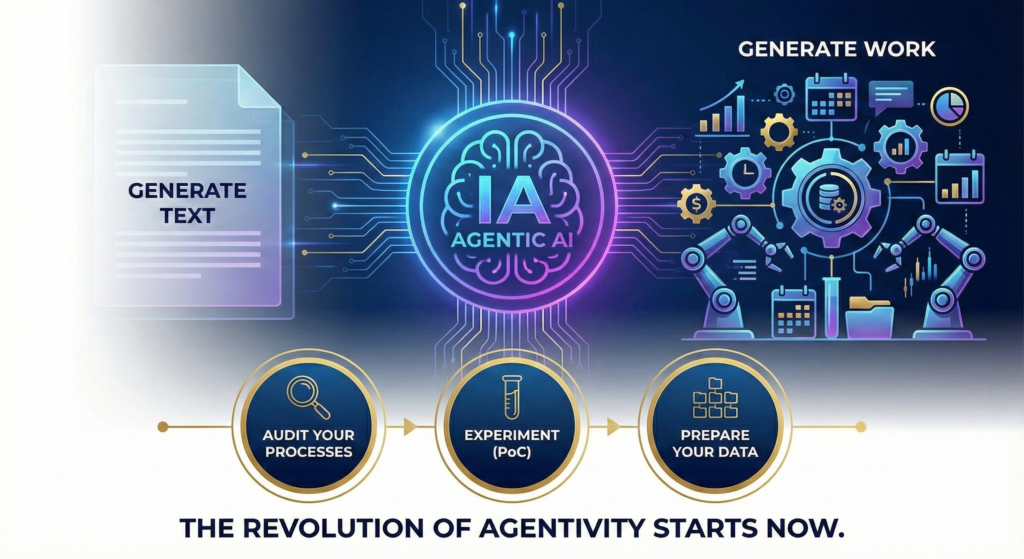
- Audit your processes: Identify tasks where your employees act as human “copy-pasters” between two pieces of software.
- Experiment: Do not launch a total overhaul. Start with a “Proof of Concept” on a limited scope (e.g., automatic appointment scheduling).
- Prepare your data: An agentic AI is only as good as the APIs and data it accesses. Clean, structured data is the fuel.
In the next three years, companies using AI solely to “generate text” will become obsolete compared to those using AI to “generate work.” The revolution of agency begins now.
Are you interested in this topic? Would you like to discuss it? Make an appointment here.
Source : https://blog.google/technology/developers/interactions-api/
