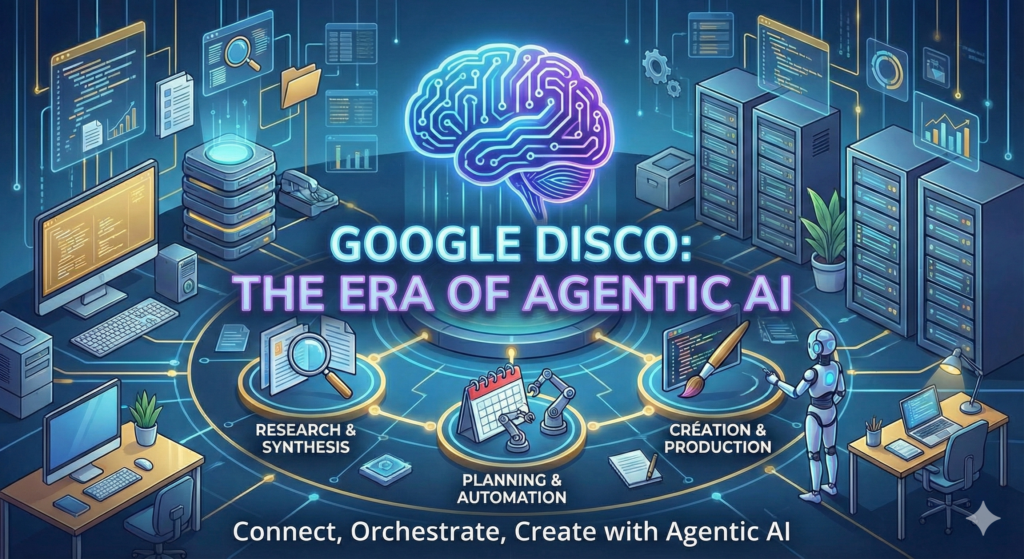
Web browsing as we have known it for 30 years—a sequence of clicks, open tabs, and laborious mental synthesis—has just died. or at least, it has been rendered obsolete by Google. With the experimental launch of Disco and its flagship feature GenTabs, powered by the all-new Gemini 3 model, the Mountain View giant is no longer just organizing information. It is recompiling it in real-time.
This is not a simple Chrome update. It is an economic paradigm shift: we are moving from a “Search” economy to a “Generative UI” (User Interface) economy.
1. THE CONTEXT: THE END OF “TAB FATIGUE”
To understand the disruption, one must look at the current pain of the market. The knowledge worker spends an average of 20% of their time simply managing information. You know the scenario: you are planning a marketing strategy or a business trip. The result? 45 open tabs, an Excel file to paste links, a Word doc for notes, and an overwhelming mental load to connect the dots between “Tab 4” and “Tab 32.”
This is known as Tab Fatigue. Until now, the browser was a passive window. With GenTabs, the browser becomes an Active Agent.
Google Labs’ announcement unveils “Disco,” an experimental environment where AI doesn’t just respond with text (like ChatGPT or Gemini 1.5). It observes your open tabs, understands your intent (“I’m planning complex logistics”), and builds an interactive web application dedicated to that task, instantly.
Why is this historic? Because for the first time, the user doesn’t need to find an application to solve their problem. The browser creates the application for them, on the fly.
2. UNDER THE HOOD: THE TECHNICAL ARCHITECTURE
For GenTabs to work, a major evolution of the “engine” was required: the arrival of Gemini 3. Let’s break down the mechanics for non-engineers.
The Brain: Gemini 3 and Multimodal Reasoning
GenTabs is not a simple text summarizer. It relies on the Agentic Reasoning capability of Gemini 3.
- Definition – Agentic: A system that doesn’t just talk, but can act, plan, and execute a sequence of complex actions to achieve a goal.
Imagine Gemini 3 is a gifted construction manager. When you tell it “Organize this trip,” it doesn’t give you a list of links. It:
- Reads the content of all your open tabs (contextual reading).
- Structures the data (prices, dates, locations, weather).
- Codes a user interface (HTML/CSS/JavaScript) in real-time.
From Unstructured Information to Structured Interface (UI)
This is the major technical feat. The web is “unstructured” (text and images in bulk).
- The Process: Gemini 3 analyzes the DOM (Document Object Model—the skeletal code of a web page) of your tabs. It extracts entities (e.g., “Tokyo Hilton Hotel”, “Price: $200”) and reinjects them into new code that it generates instantly.
- Analogy: It’s as if you gave an assistant a pile of messy books on the floor, and in 3 seconds, they built you a custom bookshelf, organized by color and author, with an interactive index.
Latency and Inference
For the experience to be fluid (“magical”), Latency (the AI’s reaction time) must be minimal. Gemini 3 has been optimized for ultra-fast Inference.
- Definition – Inference: This is the moment when the AI “thinks” and produces the result. In the case of GenTabs, inference is heavy because it must generate functional code, not just text. Google likely uses next-generation TPUs (Tensor Processing Units) to make this near-instantaneous.
3. THE OPERATIONAL IMPACT: THE TRINITY OF VALUE
For a company, adopting a technology like GenTabs (which will eventually trickle down to Chrome Enterprise) is measured in financial KPIs.
A. Efficiency: Compressing Research Time
An internal study (hypothetical based on similar cases) suggests that synthesizing complex information takes a junior analyst 4 hours. With GenTabs, creating the “Synthesis Dashboard” takes 30 seconds. The analyst no longer spends time copy-pasting data, but analyzing the generated dashboard.
- Estimated Gain: +30% productivity on strategic research tasks.
B. Profitability: Reducing “SaaS Debt”
This is a subtle but destructive point for the software market. Today, companies pay fortunes for “Dashboarding,” “Project Management,” or “Comparison” tools. If your browser can create an ad-hoc supplier comparator simply by looking at 5 open supplier sites, do you still need expensive third-party software to do that comparison? GenTabs threatens utility micro-SaaS (Software as a Service).
C. Automation: The “Augmented” Employee
GenTabs acts as Cognitive Middleware. It sits between the employee and the chaos of the web.
- Before: The employee had to translate the language of the web (disparate sites) into business language (Excel, PowerPoint).
- After: GenTabs does this translation. The employee becomes a decision-maker, no longer a “data assembler.”
4. CASE STUDY: “LOGISTICS CORP” (Scenario)
Let’s take a fictional SME, Logistics Corp, an importer of electronic components.
The Scenario: The semiconductor crisis resumes. The Purchasing Director, Mark, needs to find 5,000 units of a specific processor, at the best price, deliverable in 2 weeks.
- BEFORE (The Classic Method):
- Mark opens 15 tabs: Alibaba, DigiKey, Mouser, carrier sites, currency converter.
- He navigates between tabs, writes prices on a sticky note, loses info, starts over.
- He has to manually calculate customs duties on another site.
- Time: 3 hours. High risk of error.
- AFTER (With GenTabs & Gemini 3):
- Mark opens the 5 supplier sites.
- He types into the Disco sidebar: “Compare these suppliers for 5000 units, include freight to Paris, and convert everything to Euros. Display this as a decision table with color coding for the shortest lead time.”
- GenTabs activates. It scans the 5 tabs. It understands pricing structures. It “hallucinates” (in the good sense: it creates) a temporary web application.
- An interactive dashboard appears. Mark can click “Sort by Price.” An interactive map shows shipping routes.
- Time: 5 minutes. Mark makes his decision immediately.
5. RISKS, LIMITS, AND ETHICS
Enthusiasm must not mask critical challenges.
- Structural Hallucination: LLMs (Large Language Models) sometimes “hallucinate” (invent facts). If Gemini 3 makes a mistake extracting a price or a deadline, and presents it in a “clean and official” interface, the error becomes invisible and dangerous. Human verification (Human-in-the-loop) remains imperative.
- Privacy and Data Confidentiality: For GenTabs to work, the AI must “read” everything open in your browser. If you have a tab with confidential company data open next to it, does Gemini 3 access it? The line between “contextual help” and “corporate surveillance” is thin. Google will need to guarantee that enterprise data is not used to re-train the public model.
- The Web Economy and Publishers: If GenTabs extracts info from sites to create a perfect interface, the user never really visits the original sites (no clicks on ads, no navigation). This is the “Zero-Click” syndrome pushed to the extreme. This could kill the business model of the content creators GenTabs feeds on.
6. CONCLUSION & STRATEGIC VISION
With GenTabs and Disco, Google is attempting a masterstroke to regain the upper hand against OpenAI and Perplexity. They are no longer fighting over “who has the best answer,” but over “who offers the best work interface.”
Vision for the next 3 years: The browser will no longer be an application. It will become the enterprise Operating System (OS). Applications will no longer be downloaded or bought; they will be generated on demand for a lifespan of 10 minutes, then discarded. We are entering the era of “Disposable Software.”
Advice for decision-makers: Do not view this as a gadget. Start training your teams in “Structural Prompt Engineering.” Tomorrow, knowing how to ask an AI to build a tool will be more valuable than knowing how to use Excel.
Are you interested in this topic? Would you like to discuss it? Make an appointment here.
