

Expert Analysis: The web is on the brink of cognitive saturation. While Generative AI is democratizing text production at near-zero marginal cost, value no longer lies in the act of writing itself, but in strategy, brand identity, and semantic precision. Here is how AI Editorial, the studio led by Sarah at DigitalHS, is redefining the rules of the game by merging the raw computational power of AI with the irreplaceable nuance of the human mind.
1. THE CONTEXT: The End of “Content for Content’s Sake” and the Rise of Scarcity
To fully grasp the mission of AI Editorial, one must first analyze the economic earthquake shaking digital marketing. Until 2022, the rule was simple: “Content is King.” Publishing regularly was enough to gain visibility.
Today, we are experiencing Content Inflation. With the advent of models like GPT-4 or Claude, anyone can generate 50 articles in an hour. The consequence? Digital pollution. The web is flooded with generic, soulless, and often factually dubious text. For a corporation, publishing average content is no longer just useless—it is toxic to its brand reputation.
This is where the strategic disruption offered by AI Editorial comes into play. The goal is no longer to produce more, but to produce better and smarter. We are shifting from a volume economy to an attention and authority economy.
Key Definitions to understand the stakes:
- SEO (Search Engine Optimization): The art of optimizing content to appear at the top of Google’s results (the classic blue links).
- GEO (Generative Engine Optimization): This is the new frontier. It involves optimizing content so that it is cited as the primary source by AIs (like ChatGPT, Bing Chat, or Google Gemini) when a user asks them a direct question. This is a core pillar of Sarah’s offering.
- Content Shock: A theory suggesting that the volume of content produced far exceeds human capacity to consume it, rendering content marketing ineffective without exceptional quality.
2. UNDER THE HOOD: The Engineering of Augmented Writing
How do Sarah and the AI Editorial studio achieve this superior quality? It isn’t simply about asking ChatGPT to “write me an article.” It is complex engineering.
The Role of AI: The Logical Super-Assistant
Imagine Artificial Intelligence not as a writer, but as a librarian on steroids. LLMs (Large Language Models) operate probabilistically. They predict the most likely next word in a sentence based on massive datasets.
- Brute Force: They can analyze thousands of pages of competitor data in seconds.
- Structure: They excel at organizing ideas logically.
- The Limitation: They possess no “truth” or lived experience. Without guidance, they “hallucinate” (invent facts) or produce platitudes.
The Role of Sarah: The Architect and the Guardrail
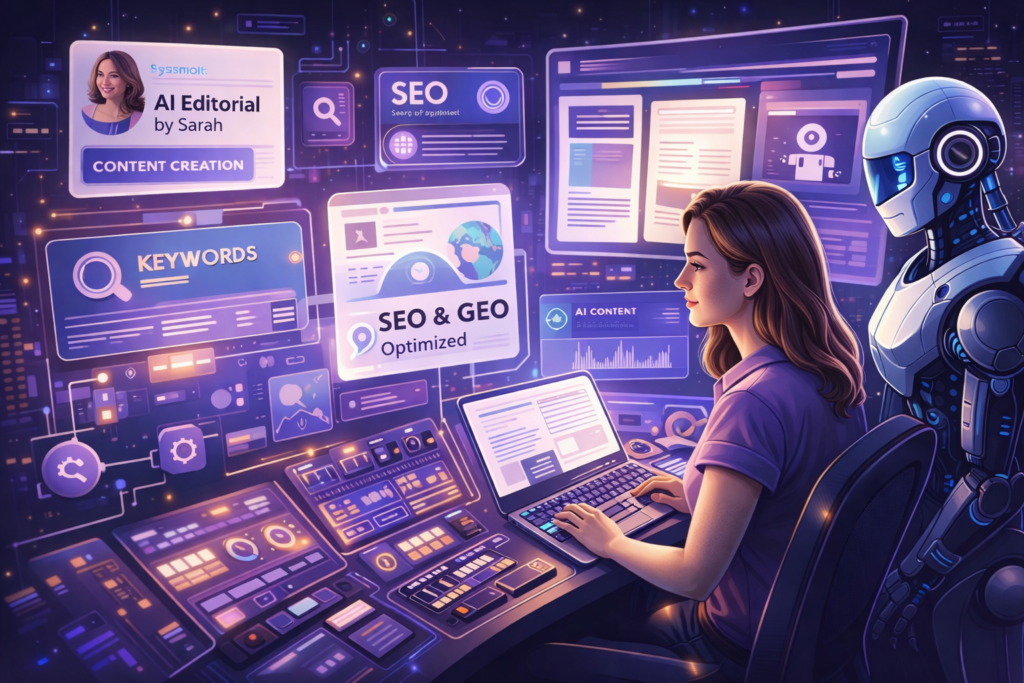
At AI Editorial, the human is not replaced; they are elevated to the role of strategist. Sarah leverages AI for repetitive cognitive tasks (research, outlining, first drafts) to focus entirely on the “Value Layer.”
This layer includes:
- Search Intent: AI can see what people are searching for, but Sarah understands why they are searching for it (are they anxious? in a rush? ready to buy?).
- Tone of Voice: AI has a robotic default “accent.” Sarah injects the client company’s DNA so the text “sounds” human.
- Advanced Semantic Optimization: To appeal to new GEO engines, repeating keywords is obsolete. One must create semantic clusters (groups of related concepts) that prove to the algorithm that you are an absolute expert on the subject.
Analogy: If content creation were building a house, AI would be the construction crew laying bricks at breakneck speed. Sarah is the architect who drew the blueprints, checks the structural integrity of the foundation, and selects the interior design to make the house habitable and unique.
3. OPERATIONAL IMPACT: The Trinity of Value (Efficiency, Authority, Conversion)
AI Editorial’s approach is not measured in word counts, but in concrete business impact. Here is the analysis of value added across three axes.
A. Efficiency & Scalability
In a traditional agency, writing a 3,000-word deep-dive dossier takes about 15 to 20 hours of human labor. With the AI Editorial methodology:
- The research phase is reduced by 80%.
- First draft generation is near-instantaneous.
- The Gain: Sarah can dedicate 100% of her time to strategic analysis and refinement. The client receives “Expert” level content in half the time, allowing for a higher publication frequency without sacrificing quality.
B. Brand Authority & E-E-A-T Criteria
Google uses a concept called E-E-A-T (Experience, Expertise, Authoritativeness, Trust) to rank websites.
AI alone often fails on the “Experience” and “Trust” criteria. Sarah bridges this gap by injecting nuance, real-world case studies, and a strong point of view.
- P&L Impact (Profit & Loss): A brand perceived as an authority can command higher prices and reduce its sales cycle because trust is established before the first commercial contact.
C. Conversion: From Reader to Client
“Filler content” does not convert. AI Editorial structures text with sales psychology. Each paragraph must validate a reader’s objection and gently nudge them toward action (CTA – Call to Action).
- AI analyzes data to know which arguments work.
- The human writes the emotion to trigger the action.
4. CASE STUDY: “LogistiPro” (Implementation Scenario)
To illustrate the power of the AI Editorial offering, let’s look at a fictional B2B SME, LogistiPro, a software provider for logistics carriers.
THE SITUATION (BEFORE):
LogistiPro handed its blog to an intern using ChatGPT without a methodology.
- Result: Articles titled “What is logistics?” (too basic).
- Metrics: Low traffic, 85% bounce rate (people leave immediately), zero demo requests. Google penalized the site for “unhelpful content.”
THE AI EDITORIAL INTERVENTION (AFTER):
Sarah takes the helm.
- AI Audit: She identifies that LogistiPro’s clients aren’t searching for “logistics,” but for “truck fleet fuel cost reduction 2026.”
- Hybrid Production: She uses AI to parse the latest European regulations (a tedious task) and structure a technical guide.
- The Sarah Touch: She interviews LogistiPro’s CTO to include real anecdotes and adjusts the tone to be “Director to Director” (B2B), not academic.
- GEO Optimization: She formats answers specifically to be picked up by the voice assistants of fleet managers.
THE RESULTS (6 MONTHS LATER):
- Qualified Traffic: +150%. It is no longer students reading, but decision-makers.
- Lead Generation: The downloadable technical guide generates 20 qualified leads per week.
- Positioning: LogistiPro is cited by Perplexity.ai as the software reference in the sector.
5. RISKS, LIMITS, AND ETHICS
It would be dishonest to say AI is risk-free. This is why Sarah’s approach is vital.
- The Hallucination Risk: An AI can invent a law or a statistic with total confidence. Without Sarah’s expert supervision, this can lead to legal risks for the brand.
- The “Grey Goo” Risk: If everyone uses the same prompts, all websites will eventually look the same. Human intervention is the only guarantee of differentiation.
- Data Privacy: AI Editorial uses secure tools to ensure that clients’ strategic data is not used to train public models.
6. CONCLUSION & STRATEGIC VISION
DigitalHS’s AI Editorial offering is not selling text. It is selling sustainable visibility in a rapidly mutating digital world.
Companies that ignore AI will be outpaced by the speed of their competitors. Those that use AI without human supervision will lose their credibility and their soul. The middle path, that of the “Centaur” (Man + Machine) embodied by Sarah, is the only winning strategy for the next 3 years.
Your content must work as hard as your business. To do so, it requires two engines: the inexhaustible power of the artificial and the emotional intelligence of the human. That is the promise of AI Editorial.
Are you interested in this topic? Would you like to discuss it? Make an appointment here.